GADGET GUIDE
Best Gadgets for Bike Riders in India
A practical guide to motorcycle technology for navigation, tyre pressure support, roadside lighting, vehicle tracking and rider communication. Choose according to the riding problem you actually need to solve.
By InstaPickr TeamUpdated
bike rider gadgetsmotorcycle technologybike navigationtyre inflatorGPS trackerhelmet Bluetooth headsetroadside essentials
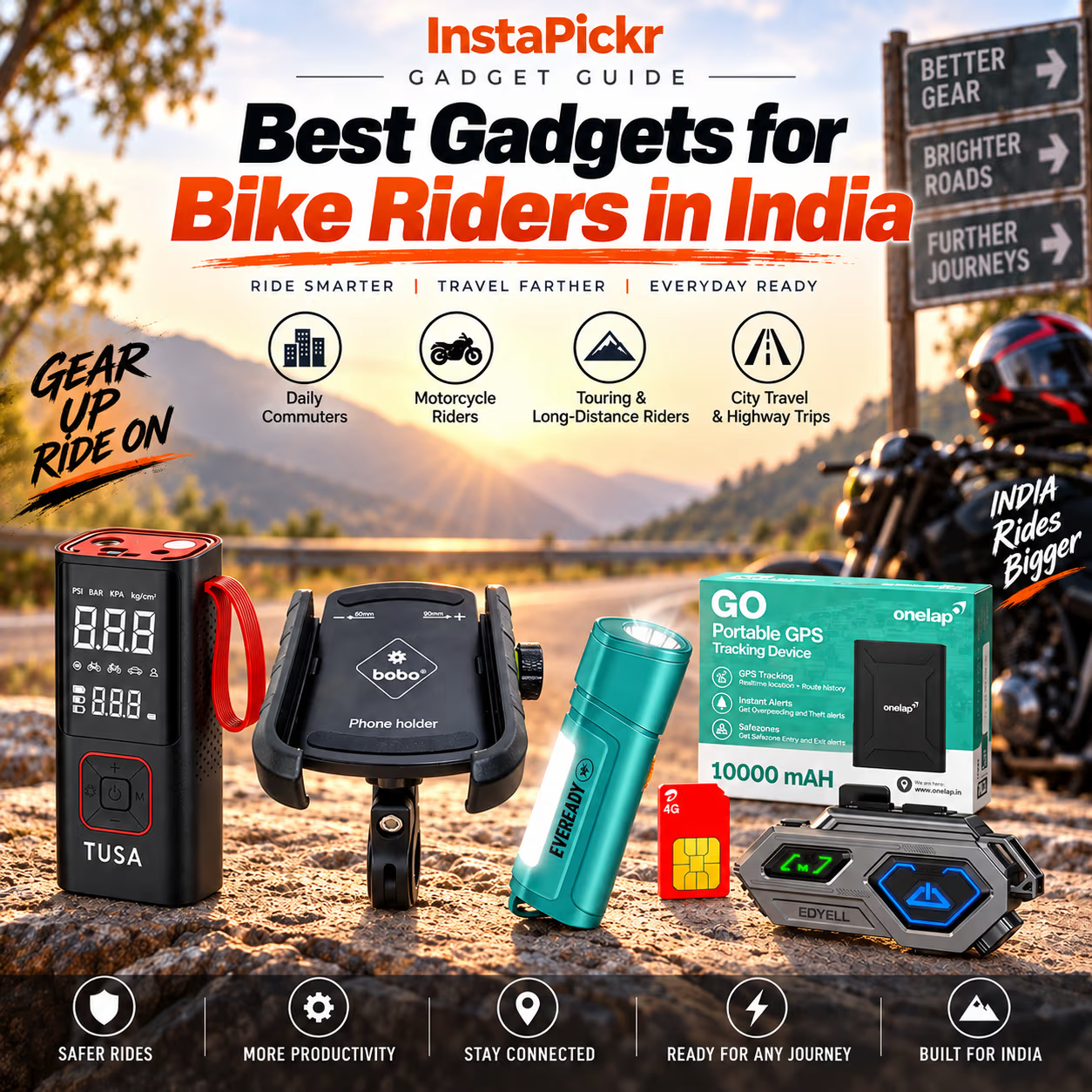
About This Gadget Guide
Useful motorcycle technology should solve a problem that riders regularly encounter rather than simply add another accessory to the bike. Depending on how and where you ride, that could mean keeping a navigation screen accessible, carrying a way to inflate a tyre, having a portable light for a roadside stop, checking a vehicle's location or maintaining communication during longer journeys.
The right combination will vary considerably between a daily commuter and someone who spends hours on highways or touring routes. A city rider may prioritise convenient navigation, while frequent road travellers may place more value on portable equipment that can be carried for tyre pressure or low-light situations.
Start by identifying the situations you actually encounter. Consider where the gadget will be mounted or stored, whether it works with your phone, helmet or vehicle setup, and what charging or installation requirements it introduces. For phone-related products, set up navigation or controls before moving and stop safely when interaction is required.
Recommended Gadgets
Explore useful gadget recommendations based on different needs and use cases.
Portable Tyre Pressure Support
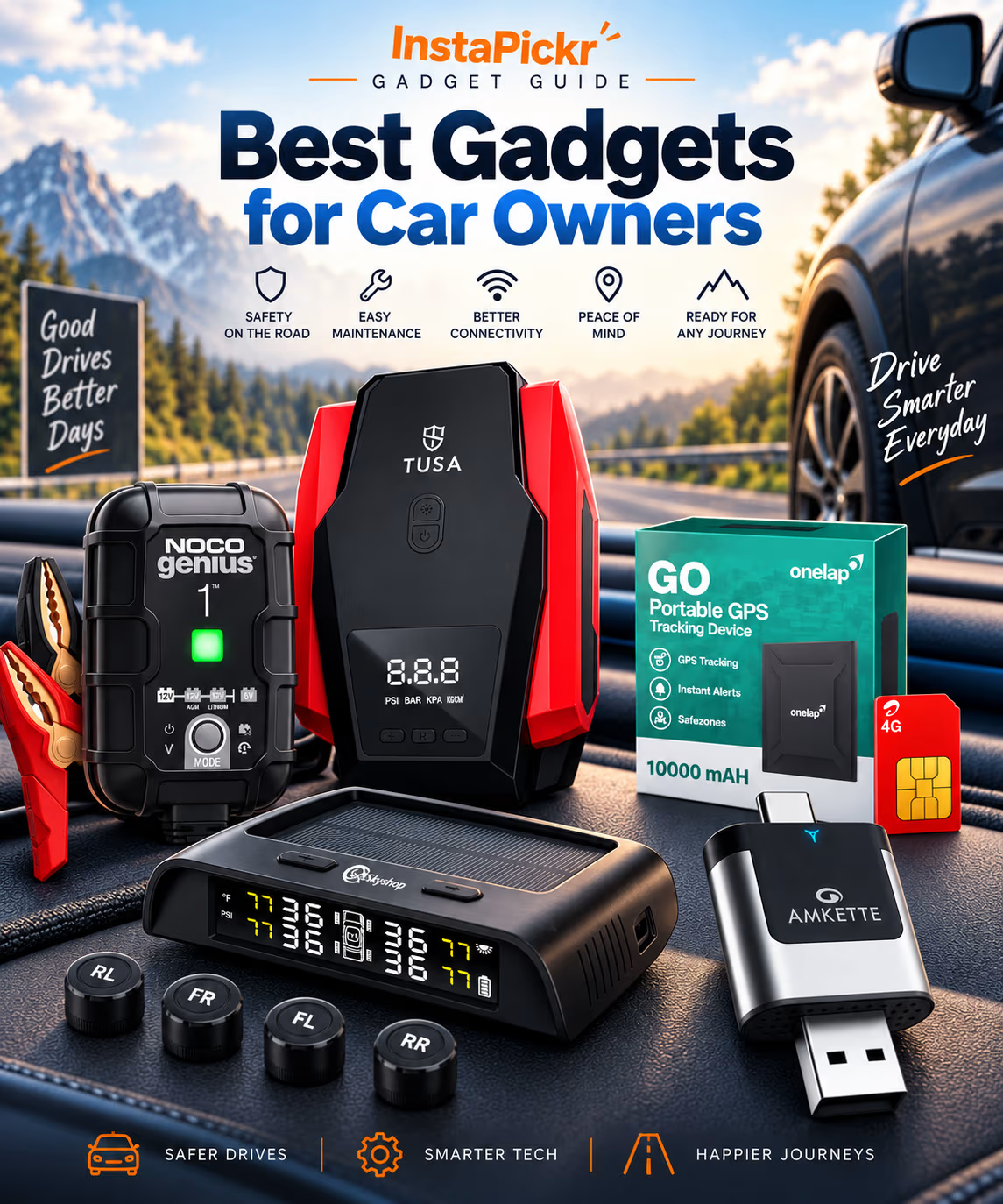
TUSA Storm X Cordless Tyre Inflator - Wired + Wireless
tusaBest for
Riders who want a portable way to inflate motorcycle tyres
Its cordless operation, digital pressure gauge, preset auto-stop function and supplied support for motorcycle inflation make it useful for riders who want tyre inflation equipment they can carry on road journeys.

Mounted Navigation Access
BOBO BM4 Jaw-Grip Waterproof Bike Mobile Phone Holder
boboBest for
Riders who regularly use smartphone maps or GPS navigation
The adjustable jaw grip supports 4.0- to 7.0-inch phones, while the supplied handlebar and scooter mounting hardware makes it relevant to different two-wheeler setups.
Light for Roadside Stops
EVEREADY Pocketlite DL100
evereadyBest for
Riders who want compact illumination for night-time stops
It combines a focused 1W torch with a wider 2W sidelight in a rechargeable handheld design, giving riders two lighting options when they need illumination while stopped.
Motorcycle Location Tracking
Onelap GO Wireless GPS (with 4G SIM) - GPS Tracking Device
onelapBest for
Riders who want app-based vehicle location information
Real-time GPS tracking, full-day location history and a magnetic portable design make it suited to riders who want to check their vehicle's location through the Onelap mobile app.
Helmet Communication
EDYELL C8 Pro Motorcycle Bluetooth Headset
edyellBest for
Touring riders who want helmet-based communication and audio controls
Its communication support, voice-control button, automatic call answering and helmet-focused design make it relevant to riders who want connectivity without relying on a handheld phone.
Detailed Recommendations
A closer look at each recommended gadget, who it is best suited for, why it is useful, and what you should consider before buying.
Best For
Portable motorcycle tyre inflation on commutes and road trips
Why We Recommend It
The Storm X supports motorcycle inflation and operates cordlessly from its 6000mAh rechargeable battery. Riders can set the required pressure using its digital gauge, choose between PSI, BAR, KPA and Kg-cm² units, and use the automatic stop function once the preset pressure is reached. Its built-in LED also provides illumination when working in darker conditions.
Why It's Useful
Tyre pressure can need attention away from a convenient air station, particularly on longer journeys. A portable inflator gives riders a way to add air to a motorcycle tyre without making a tyre pump part of a permanent garage-only setup.
Consider it if you commute over longer distances, tour regularly or simply prefer carrying your own tyre inflation equipment instead of depending entirely on roadside air facilities.
Riders who already carry a suitable portable inflator, or who rarely travel beyond areas where their preferred tyre-inflation facilities are readily available, may not need another device for the same purpose.
What We Like
Cordless operation makes it practical for carrying on a motorcycle, while the digital pressure display and preset auto-stop function reduce the need to manually judge when the selected pressure has been reached. The supplied nozzles also extend its usefulness beyond motorcycles.
What to Consider
The cordless battery requires recharging, with a stated full Type-C charging time of three hours. The supplied description of wired operation specifically refers to a car's 12V DC port, so motorcycle riders should not assume wired compatibility with their own bike unless their setup is separately confirmed.
Best For
Keeping a compatible smartphone positioned for maps and GPS navigation
Why We Recommend It
The adjustable jaw mechanism accommodates phones with 4.0- to 7.0-inch screens and can be tightened to the phone's width using the side knob. Its design also keeps the phone's buttons and ports accessible, while the supplied hardware supports multiple common mounting arrangements.
Why It's Useful
Navigation is one of the most practical reasons to mount a smartphone on a motorcycle or scooter. A dedicated holder keeps the screen in a fixed position instead of requiring the phone to be carried in the rider's hand when checking directions.
It is suited to commuters, delivery-style city riders, touring riders and others who regularly depend on smartphone navigation and have a compatible phone and mounting location.
Riders who rarely use phone-based navigation, prefer keeping their phone stored away, or do not have a compatible phone size or mounting position have less reason to install it.
What We Like
The adjustable grip avoids relying on foam pads or silicone retaining bands, and the package includes a rear-view mirror mount for scooters as well as a metal buckle and spacers for 22, 25 and 32 mm handlebar diameters.
What to Consider
Check both phone size and mounting dimensions before choosing it. The supplied information supports phones from 4.0 to 7.0 inches and specifies 22, 25 and 32 mm handlebar fitments. Navigation should be configured before setting off, and phone interaction should be left for a safe stop rather than performed while actively riding.
Best For
Portable lighting during night-time roadside stops
Why We Recommend It
The Pocketlite DL100 provides two distinct lighting options: a 1W torch for focused illumination and a 2W sidelight for lighting a wider area. Its compact ABS body, balanced design and simple slide switch support straightforward one-handed use.
Why It's Useful
A compact light can be useful when a rider needs to inspect belongings, look around a parked motorcycle or illuminate an area during a stop after dark. A separate handheld light also remains useful away from the motorcycle itself.
It makes sense for riders who frequently travel after dark, take longer road trips or want a rechargeable light packed with their regular motorcycle travel equipment.
Daytime-only riders or people who already carry a suitable rechargeable torch for roadside and travel use may not gain much from adding another dedicated light.
What We Like
The combination of focused and wider-area lighting gives it more than one practical role. It also includes a charging indicator plus overcharge and deep-discharge protection for its rechargeable battery.
What to Consider
It uses Micro USB charging and has a stated full charging time of 3.5 hours. The supplied information describes it as a handheld torch and sidelight rather than a motorcycle-mounted riding light, so its clearest role in this guide is illumination while stopped.
Best For
Checking a motorcycle's location and reviewing recent travel history
Why We Recommend It
The Onelap GO provides real-time GPS tracking and full-day location history through Android and iOS apps. It includes a pre-installed 4G SIM, stores data in the cloud with end-to-end encryption, and uses a magnetic body that supports portable attachment and concealed placement.
Why It's Useful
A location tracker gives owners another way to check where a vehicle is and review its recent movement without needing to be physically beside it. This can be useful for riders who regularly park away from home or want an app-based location record.
It is most relevant to motorcycle and scooter owners who specifically want remote location visibility and are comfortable managing tracking through the Onelap app.
Riders who do not need remote location information or travel history, or who do not want another app-connected device associated with their vehicle, may have little reason to add a dedicated tracker.
What We Like
The combination of real-time tracking, location history and a self-contained rechargeable design gives it a clearly defined vehicle-monitoring role. Voice monitoring is also supported by calling the tracker from the user's own calling SIM.
What to Consider
Using its tracking features depends on the Onelap Android or iOS app and the device's 4G SIM connectivity. Although the supplied information specifies a 10000mAh battery, it does not state operating runtime, so charging frequency cannot be assessed from the provided details. It provides location information but should not be treated as a guarantee against theft or as a guarantee of vehicle recovery.
Best For
Helmet-based communication and connected controls on longer rides
Why We Recommend It
The C8 Pro supports up to 40 hours of communication and communication distances of up to 600M according to the supplied information. It also includes automatic call answering after 10 seconds, a dedicated voice-control button for a voice assistant or Siri, button-based playback controls and IPX6 water resistance.
Why It's Useful
Touring and long-distance riders may want communication, calls or audio controls available through a helmet-oriented device instead of depending on direct interaction with a smartphone.
It is suited to touring riders, long-distance riders and others who specifically want helmet-based communication or voice-access features during their motorcycle journeys.
Riders who prefer riding without calls, audio or connected helmet functions, or who rarely have a use for rider communication, may be better served by keeping their helmet setup simpler.
What We Like
Long stated communication time, dedicated physical controls and voice-assistant access give the headset several ways to manage connected functions without depending entirely on the phone itself. The supplied product information also states compatibility with all helmets
What to Consider
Automatic call answering after 10 seconds may be an important behaviour for riders who prefer choosing manually when a call connects. Its IPX6 rating should also be treated as the supplied level of water resistance rather than assumed to provide protection beyond that specification. Any controls or connected functions should be used in a way that does not distract from riding.
How We Choose
We selected these recommendations according to the practical problems they address for motorcycle users rather than treating unrelated gadget categories as direct competitors. The focus is on whether each device has a clear role during commuting, touring, parking or roadside stops.
- Practical purpose: Each gadget needs to address a recognisable riding or travel-related task rather than exist primarily as a novelty accessory.
- Portability or installation: We consider whether the product can realistically be carried on a motorcycle or fitted into a rider's existing setup using the supplied mounting information.
- Compatibility: Phone dimensions, mounting sizes, app support and other stated compatibility requirements matter because a useful feature has little value when it does not suit the rider's equipment.
- Power requirements: Rechargeable gadgets need to fit the rider's charging routine, particularly when they are intended for longer journeys.
- Ease of use: Features such as preset controls, straightforward mounting, simple switches and accessible physical controls can make a gadget more practical for repeated use.
- Real-world boundaries: We also consider what the supplied information does not establish. A tracker, inflator, torch or headset should be chosen for its stated function rather than treated as a guarantee against theft, breakdowns or other road incidents.
Final Verdict
The most useful gadget depends on the part of motorcycle ownership or travel you want to make easier. Navigation-focused riders may benefit most from a secure phone mounting setup, while frequent road travellers may place greater value on portable tyre inflation or rechargeable lighting. A GPS tracker serves riders who specifically want location visibility, while a helmet headset is more relevant to those who need communication and connected controls on longer journeys.
Choose according to your routes, existing equipment and how often the problem actually occurs. None of these products needs to be treated as essential for every rider; their value comes from matching a specific tool to a specific riding need.
Related Articles
Explore more guides and useful content related to this topic.